How to Choose the Right International Primary School Curriculum: IB, British, American, and Beyond

Why Curriculum Choice Matters More Than You Think
The curriculum your child follows in primary school does far more than determine what they learn — it shapes how they learn to learn. The habits formed in these early years, from how children approach a problem to how they respond to assessment pressure, tend to stick.
Parents enrolling in international schools often focus on location, fees, and reputation. Curriculum tends to be an afterthought. That's a mistake worth avoiding early, because switching systems mid-primary — say, from an American framework to the British National Curriculum — can mean a child suddenly faces unfamiliar assessment styles, different progression expectations, and in some cases, gaps in foundational content.
There's also the transition question. A child who completes Key Stage 2 under the British curriculum will find the move to a British secondary school relatively seamless. A child who has spent four years in an IB Primary Years Programme school may need an adjustment period if they transfer to a more structured, subject-specific environment. None of this is insurmountable, but it's worth thinking through before you sign an enrollment form.
A Plain-Language Overview of the Main Curriculum Types
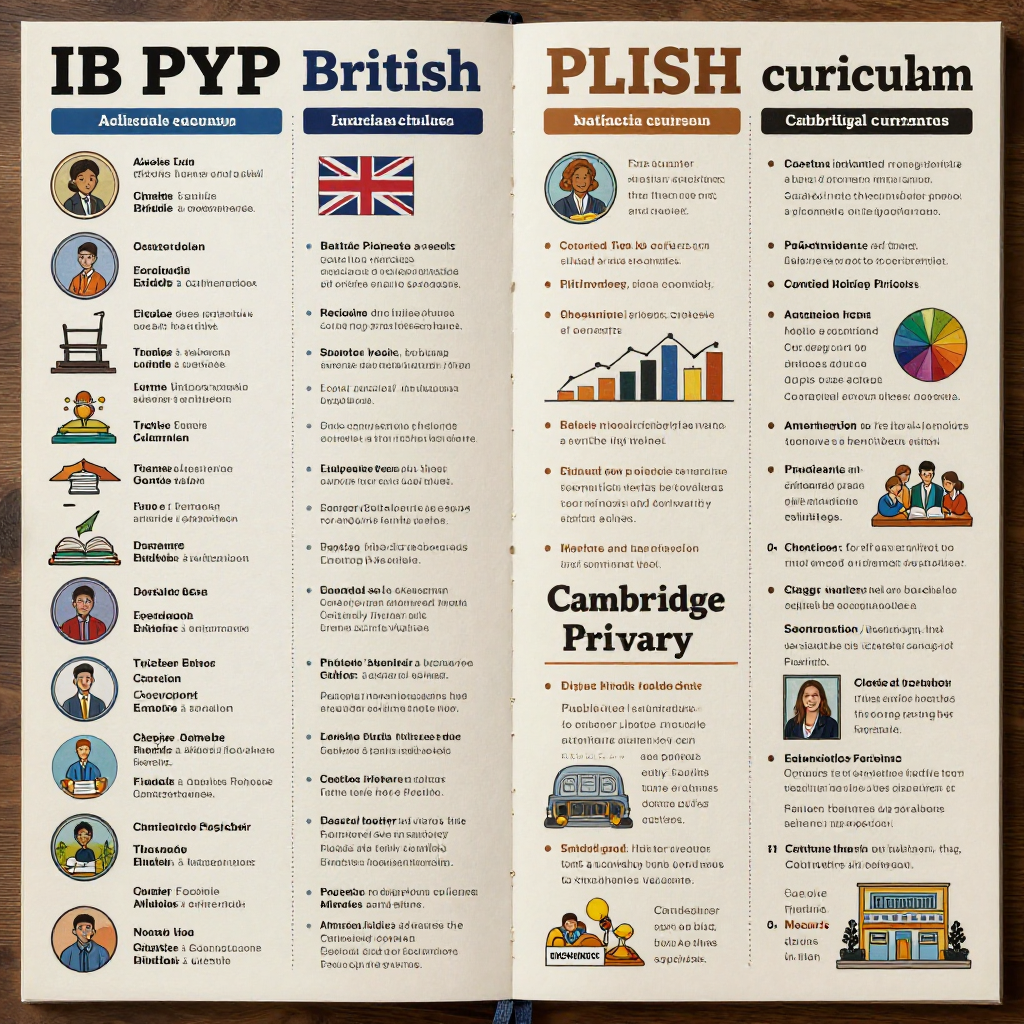
Each major international primary curriculum has a distinct philosophy, structure, and assessment approach. Here's what each one actually looks like in practice.
International Baccalaureate – Primary Years Programme (IB PYP)
The IB Primary Years Programme is an inquiry-based learning framework designed for children aged 3 to 12. Rather than organizing content by traditional subjects, the PYP uses six transdisciplinary themes — such as "How We Organize Ourselves" or "Sharing the Planet" — through which children explore ideas across disciplines simultaneously. Assessment is largely portfolio-based and teacher-led, with minimal standardized testing at primary level. The IB Organization oversees authorization and quality assurance globally.
British National Curriculum (Key Stages 1 and 2)
The British curriculum follows a structured, subject-by-subject progression through Key Stage 1 (ages 5–7) and Key Stage 2 (ages 7–11). Core subjects — English, mathematics, and science — receive the most instructional time, with clear attainment targets at each stage. Assessment includes national-style tests (SATs) at the end of KS2. British international schools typically follow the same framework as schools in England, making transitions to the UK relatively straightforward.
American Common Core / US Curriculum Framework
American international schools generally follow a grade-based system (Kindergarten through Grade 5 or 6 at primary level), often aligned with Common Core State Standards for English Language Arts and mathematics. The approach tends to blend structured instruction with project-based elements, and assessment varies significantly by school. One practical advantage: the US system is familiar to American families and offers a smooth path into American high schools and the college admissions process.
Cambridge Primary (CAIE)
Cambridge Primary, offered by Cambridge Assessment International Education, covers ages 5 to 11 across six subjects. It uses external Cambridge Checkpoint assessments at the end of primary, giving parents and teachers an internationally benchmarked view of a child's progress. Cambridge Primary is widely recognized across Asia, Africa, and the Middle East, making it a strong option for families based in those regions or likely to move between them.
How to Match Curriculum to Your Child's Learning Style
The best curriculum for your child depends significantly on their temperament and how they engage with learning — not just on which system is most prestigious or widely recognized.
Children who are naturally self-directed and curious, who love asking "why" and exploring ideas across subjects, tend to thrive in the IB PYP environment. The open-ended inquiry model rewards children who can manage some ambiguity and who enjoy collaborative, project-based work. If your child gets restless with repetition and lights up when given creative latitude, the PYP is worth a serious look.
On the other end of the spectrum, children who feel secure with clear expectations, defined milestones, and regular feedback often do better in the British or Cambridge Primary frameworks. Both provide explicit learning objectives and more frequent, structured assessment — which some children find reassuring rather than stressful.
American curriculum schools tend to sit somewhere in between, often blending structured core instruction with more flexible project work. For children who've already spent time in US schools, continuity alone is a legitimate reason to stay within the system.
One honest caveat: learning style isn't fixed, and children adapt. A child who struggles initially with inquiry-based learning may flourish once they build confidence. What matters is whether the school has the support structures to help during that adjustment.
Factoring in Your Family's Mobility and Long-Term Plans
For expatriate families who relocate every two to four years, curriculum portability is one of the most important practical considerations — and it's often underweighted in the initial decision.
The IB PYP has a clear advantage here. Because it's a philosophy and framework rather than a country-specific syllabus, IB-authorized schools in Singapore, Dubai, São Paulo, and Amsterdam are teaching toward the same outcomes. A child moving between IB schools experiences far less disruption than one moving between, say, a French curriculum school and an American one.
Cambridge Primary also travels well, particularly across Asia, Africa, and parts of the Middle East where CAIE-affiliated schools are concentrated. If your postings tend to cluster in those regions, Cambridge Primary offers strong continuity.
The British curriculum is highly portable within the British international school network, which is extensive. However, if your family might eventually settle outside the UK or Commonwealth countries, the transition out of the British system at secondary level requires more planning.
If your family has a clear long-term destination — say, you're planning to return to the United States when your child is 12 — then curriculum continuity with that destination probably outweighs other factors. Choosing an American curriculum school abroad and then returning to an American school is a smoother path than bridging from a very different system at a critical age.
Language of Instruction and Mother Tongue Considerations
Language is one of the most overlooked dimensions of curriculum choice, and it can significantly affect a child's confidence and academic progress — especially in the early primary years.
All four major systems are predominantly English-medium in international school contexts, but they handle bilingualism and mother tongue support differently. The IB PYP has the most explicit commitment to mother tongue maintenance, recognizing it as central to a child's identity and cognitive development. Many IB schools offer mother tongue classes or can point families toward external language support programs.
The British and Cambridge curricula focus primarily on English instruction, though many international schools running these frameworks offer additional language programs. English as an Additional Language (EAL) support quality varies enormously between schools — this is worth asking about specifically during any school visit.
American curriculum schools often offer strong EAL support and, in some cases, dual-language programs. However, the depth of mother tongue provision depends entirely on the individual school's resources and priorities.
If your child is not a native English speaker, ask every school you visit: what does EAL support look like in the first year? How is the child assessed and tracked? What happens if they're struggling at the six-month mark? The answers will tell you more about a school's actual approach than any brochure will.
Questions to Ask During a School Visit or Admissions Meeting
A school visit is your best opportunity to move beyond marketing materials and test whether a school genuinely delivers what it claims. Go in with specific questions.
- How does the school assess student progress? Ask for a sample report card or progress document. Vague answers here are a red flag.
- What does a typical week look like for a Year 3 (or Grade 3) student? This reveals how the curriculum is actually structured day-to-day, not just in theory.
- How does the school support children who are transitioning from a different curriculum system? The quality of this answer matters enormously for mobile families.
- What is the school's accreditation status, and with which body? Accreditation from recognized bodies — such as the Council of International Schools (CIS), the IB Organization, or CAIE — signals that the school has been externally evaluated against defined standards.
- What is the teacher turnover rate? High turnover in international schools often signals management or culture issues that affect curriculum delivery.
- How does the school handle mother tongue or home language support? Especially relevant if English is not your child's first language.
Don't feel pressured to fill every moment of a visit with polite conversation. The best school visits include time to observe a class in session, not just a tour of the facilities.
Making the Final Decision: A Simple Framework
When you've gathered information from multiple schools, a simple prioritization exercise can cut through the noise.
Rank these four criteria in order of importance for your family right now:
- Curriculum portability — How likely is your family to relocate, and does this system travel well to your likely destinations?
- Child fit — Does your child's learning style align with the philosophy of this curriculum (inquiry-based vs. structured)?
- Language support — Does the school adequately support your child's English development or mother tongue maintenance?
- Long-term pathway — Does this curriculum create a logical bridge to the secondary system your child is likely to enter?
The curriculum that scores highest across your top two or three criteria is almost always the right choice — even if it's not the most prestigious option on paper. A school that genuinely delivers a good Cambridge Primary education will serve your child better than a poorly implemented IB program at a more recognizable institution.
One final point: accreditation matters, but it's a floor, not a ceiling. An accredited school has met minimum standards. What you're looking for is a school that exceeds them — and you'll sense that in the quality of the conversations you have during your visit, the coherence of the teachers' answers, and the energy in the classrooms you observe.
Frequently Asked Questions
Is the IB Primary Years Programme better than the British curriculum?
Neither is objectively better — they suit different learners and different family situations. The IB PYP works well for self-directed, inquiry-oriented children and highly mobile families. The British curriculum is a strong choice for structured learners and families with ties to the UK or Commonwealth countries. The quality of the school delivering the curriculum matters more than the curriculum itself.
Can my child switch from an American curriculum school to a British one mid-primary?
Yes, and many children do this successfully. The main adjustment areas are typically in mathematics (where sequencing differs) and writing conventions. Most well-resourced British international schools have transition support in place. Give your child one full term to settle before drawing conclusions about whether the switch is working.
Does the curriculum choice at primary level affect university admissions later?
Directly, very little — university admissions are based on secondary-level qualifications (A-Levels, IB Diploma, AP courses, etc.). Indirectly, yes: the primary curriculum shapes the habits and skills a child brings into secondary school, which in turn affects how well they perform in those qualifications. Choosing a primary curriculum that transitions smoothly into a strong secondary program is the more important consideration.
What does "accredited" mean and why does it matter?
Accreditation means an independent body has evaluated the school against a set of educational standards and found it meets them. For international schools, bodies like the Council of International Schools (CIS), the IB Organization, or CAIE conduct these reviews. Accreditation matters because it provides some assurance of curriculum quality, teacher qualifications, and governance — particularly useful when you can't rely on local regulatory oversight.
How do I know if a school is truly delivering its stated curriculum well?
Ask to see student work samples, observe a class in session, and speak with current parents if possible. A school that's genuinely delivering its curriculum well will have teachers who can explain their approach clearly, student work that reflects the curriculum's stated values, and parents who feel informed about their child's progress. Glossy facilities and a well-designed website are not reliable indicators.